University of Oxford
Politics & International Relations · St John's College Centre for Technology and Society
University of Oxford

Ranjit LallProfessor of International Political Economy

I study the political economy of technological change, international cooperation, and economic development — and the methods we use to draw conclusions from incomplete evidence.

Ranjit Lall
About

Institutions, technology, and evidence

I am a Professor of International Political Economy in the Department of Politics and International Relations and a Fellow of St John's College at the University of Oxford. I am also Director of the Centre for Technology and Society, which studies the social and economic consequences of emerging technologies.

I work on how new technologies redistribute political power, why international cooperation succeeds or fails, and what drives economic development. My book Making International Institutions Work examines why some international institutions perform better than others, drawing on the most comprehensive dataset on the topic. I also have methodological interests in machine learning and the analysis of missing data, and release the datasets and software behind my research openly.

I received my PhD in Government from Harvard University and my BA in Philosophy, Politics, and Economics from the University of Oxford. Before beginning my PhD, I worked as an economist at the Bank of England and an editorial writer at the Financial Times.

Affiliations
Research themes

Four strands of work

Distinct questions, but a shared concern with what the evidence can and cannot support.

Strand I

Technological change

How AI and other emerging technologies are reshaping labour markets, redistributing economic and political power, and reordering the politics that follows from both. Much of this work now runs through the Centre for Technology and Society.

Strand II

International cooperation

Why some international institutions perform better than others, how they are held to account, and what makes bureaucratic autonomy possible in a world of states pursuing narrow interests.

Strand III

Economic development

What makes development finance work — the effectiveness of aid projects, the transparency of the agencies that run them, and the long-run historical forces that shape where prosperity takes hold.

Methods

Missing data and machine learning

Techniques for drawing valid inferences from incomplete data, including deep-learning approaches to multiple imputation and tests for conditional independence — released as open-source packages for R and Python.

Centre for Technology and Society (CTS) Centre for Technology and Society

Understanding how technology is remaking society

I am Director of the Centre for Technology and Society at the University of Oxford, part of the Oxford Martin AI Governance Initiative. The Centre produces evidence-first research on how emerging technologies are reshaping work, power, and society — concentrating where the evidence is thinnest and the stakes are highest.

Its two primary interests are the labour market implications of AI and the dispersion of power among firms, states, and citizens.

Illustration: a dense cluster of coloured points dispersing into a sparse field, within an outlined triangle
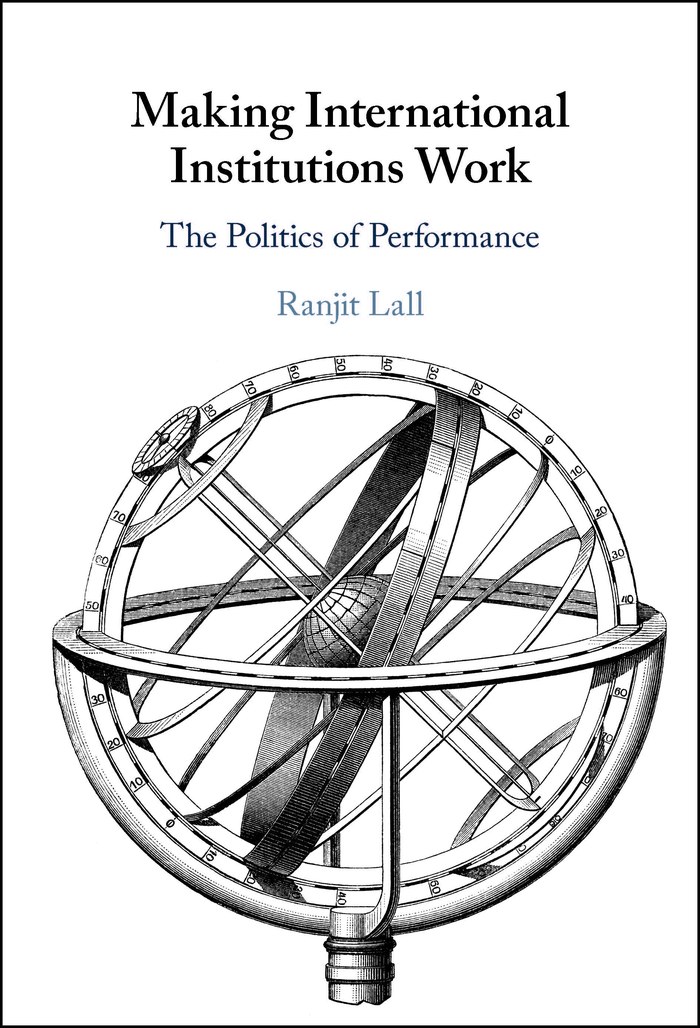
Making International Institutions Work: The Politics of Performance, by Ranjit Lall (Cambridge University Press)
Book · Cambridge University Press · 2023

Making International Institutions Work

Challenging popular characterisations of international institutions as ‘runaway bureaucracies’, the most serious threat to performance comes from the pursuit of narrow political interests by states.

International institutions are essential for tackling many of the most urgent challenges facing the world, yet we know little about when they succeed, when they fail, and why. The book proposes a new theory of institutional performance and tests it using the most comprehensive dataset on the topic.

Selected publications

Recent work

The full list — articles, chapters, and policy reports — lives on the research page.

Forthcoming

  1. APSR

    The Political Economy of Artificial Intelligence: Evidence from Western Europe

    Ranjit Lall

    Conditionally accepted, American Political Science Review

    SocArXiv preprint
    Abstract

    While advances in artificial intelligence (AI) are feared to bring about widespread job losses, workers highly exposed to the technology tend to anticipate productivity-driven improvements in their earnings and employment prospects. I argue that this paradox has important political economy implications: if labor complementarities are expected to outweigh substitution effects—raising income without commensurately intensifying employment risks—exposure to AI should weaken rather than strengthen support for redistributive policies and their political advocates. I test this argument using a combination of observational and original experimental data from Western Europe, finding that occupation-level AI exposure is negatively associated with support for redistribution, the left, and the (increasingly pro-welfare) populist right but positively associated with support for the mainstream right.

    BibTeX
    @misc{lall2026ai,
      abbr={APSR},
      bibtex_show={true},
      title={The Political Economy of Artificial Intelligence: Evidence from Western Europe},
      author={Lall, Ranjit},
      year={2026},
      note={Conditionally accepted, <em>American Political Science Review</em>},
      abstract={While advances in artificial intelligence (AI) are feared to bring about widespread job losses, workers highly exposed to the technology tend to anticipate productivity-driven improvements in their earnings and employment prospects. I argue that this paradox has important political economy implications: if labor complementarities are expected to outweigh substitution effects—raising income without commensurately intensifying employment risks—exposure to AI should weaken rather than strengthen support for redistributive policies and their political advocates. I test this argument using a combination of observational and original experimental data from Western Europe, finding that occupation-level AI exposure is negatively associated with support for redistribution, the left, and the (increasingly pro-welfare) populist right but positively associated with support for the mainstream right.},
      html={https://osf.io/preprints/socarxiv/vmgdj_v1},
      html_label={SocArXiv preprint},
      url={https://osf.io/preprints/socarxiv/vmgdj_v1}
    }

Published

  1. CPS

    Right-Wing Populism and the COVID-19 Shock: Evidence from Early Superspreader Events

    Ranjit Lall, Thomas R. Davidson, and Felix Hagemeister

    Comparative Political Studies, 1–44, 2026

    Publisher PDF DOI
    Abstract

    Can public health shocks boost right-wing populism? We investigate how the onset of the COVID-19 pandemic impacted support for populists in Western Europe, an unresolved debate on which surprisingly little systematic evidence exists. Building on theories of populist mobilization in societal crises, we hypothesize a positive aggregate effect driven by declining confidence in public institutions, intensifying hostility toward outgroups, and opposition to government restrictions. Exploiting variation in local COVID-19 incidence stemming from the idiosyncratic timing of early superspreader events, we find a rise in online engagement with populists in regions with higher infection rates. We document a similar increase in populist support in the 2020 French municipal elections and in representative British and Dutch survey data. These varied sources corroborate our three posited mechanisms while casting doubt on possible alternative economic, social, and psychological channels. The findings broaden our understanding of the types of societal shocks that foster extreme politics.

    BibTeX
    @article{lall2026cps,
      abbr={CPS},
      bibtex_show={true},
      title={Right-Wing Populism and the COVID-19 Shock: Evidence from Early Superspreader Events},
      abstract={Can public health shocks boost right-wing populism? We investigate how the onset of the COVID-19 pandemic impacted support for populists in Western Europe, an unresolved debate on which surprisingly little systematic evidence exists. Building on theories of populist mobilization in societal crises, we hypothesize a positive aggregate effect driven by declining confidence in public institutions, intensifying hostility toward outgroups, and opposition to government restrictions. Exploiting variation in local COVID-19 incidence stemming from the idiosyncratic timing of early superspreader events, we find a rise in online engagement with populists in regions with higher infection rates. We document a similar increase in populist support in the 2020 French municipal elections and in representative British and Dutch survey data. These varied sources corroborate our three posited mechanisms while casting doubt on possible alternative economic, social, and psychological channels. The findings broaden our understanding of the types of societal shocks that foster extreme politics.},
      author={Lall, Ranjit and Thomas R. Davidson and Felix Hagemeister},
      journal={Comparative Political Studies},
      pages={1--44},
      year={2026},
      doi={10.1177/00104140261448406},
      html={https://journals.sagepub.com/doi/10.1177/00104140261448406},
      pdf={Lall, Davidson, and Hagemeister 2026 CPS.pdf},
      selected={true}
    }
  2. APSR

    Consequences of the Black Sea Slave Trade: Long-Run Development in Eastern Europe

    Volha Charnysh and Ranjit Lall

    American Political Science Review 120(3), 1127–1149, 2026

    Publisher PDF DOI
    Abstract

    We investigate the developmental consequences of slave-raiding in Eastern Europe, the largest source of slaves in the early modern world after West Africa. Drawing on a wide-ranging new dataset, we estimate that at least five million people were captured from hundreds of locations across Eastern Europe between the fifteenth and eighteenth centuries. We hypothesize that, over time, raids encouraged an economically advantageous process of defensive state-building linked to raided societies’ resistance to and lack of integration into the slave trade. Using difference-in-differences and instrumental variables strategies, we find that exposure to raids is positively associated with long-run urban growth and related indicators of demographic and commercial development. Consistent with our posited mechanism, raided areas constructed more robust defensive infrastructures and attained higher levels of military, administrative, and fiscal capacity. Our findings suggest that the structure of slave production conditions its developmental legacies, cautioning against drawing generalizations from the African context.

    BibTeX
    @article{charnysh2026apsr,
      abbr={APSR},
      bibtex_show={true},
      title={Consequences of the Black Sea Slave Trade: Long-Run Development in Eastern Europe},
      abstract={We investigate the developmental consequences of slave-raiding in Eastern Europe, the largest source of slaves in the early modern world after West Africa. Drawing on a wide-ranging new dataset, we estimate that at least five million people were captured from hundreds of locations across Eastern Europe between the fifteenth and eighteenth centuries. We hypothesize that, over time, raids encouraged an economically advantageous process of defensive state-building linked to raided societies’ resistance to and lack of integration into the slave trade. Using difference-in-differences and instrumental variables strategies, we find that exposure to raids is positively associated with long-run urban growth and related indicators of demographic and commercial development. Consistent with our posited mechanism, raided areas constructed more robust defensive infrastructures and attained higher levels of military, administrative, and fiscal capacity. Our findings suggest that the structure of slave production conditions its developmental legacies, cautioning against drawing generalizations from the African context.},
      author={Charnysh, Volha and Ranjit Lall},
      journal={American Political Science Review},
      volume={120},
      number={3},
      pages={1127--1149},
      year={2026},
      doi={10.1017/S0003055426101439},
      url={https://www.cambridge.org/core/journals/american-political-science-review/article/consequences-of-the-black-sea-slave-trade-longrun-development-in-eastern-europe/E6074298B3135E3B858CF9E64BE45F99#article},
      html={https://www.cambridge.org/core/journals/american-political-science-review/article/consequences-of-the-black-sea-slave-trade-longrun-development-in-eastern-europe/E6074298B3135E3B858CF9E64BE45F99#article},
      pdf={Charnysh and Lall 2026 APSR.pdf},
      publisher={Cambridge University Press},
      selected={true}
    }
All publications →
Data & software

Open datasets and packages

Datasets and open-source tools from my research, hosted on GitHub, CRAN, PyPI, and Dataverse.

All data & software →
Contact

Get in touch

Email is the best way to reach me.

ranjit.lall@sjc.ox.ac.uk →

Address
N4-3 St John's College
St Giles', Oxford
OX1 3JP
United Kingdom

Affiliations