

Research
Books, journal articles, conference proceedings, chapters, and policy reports. Abstracts and BibTeX expand in place; every entry links to the publisher and to a PDF.
-
CUP
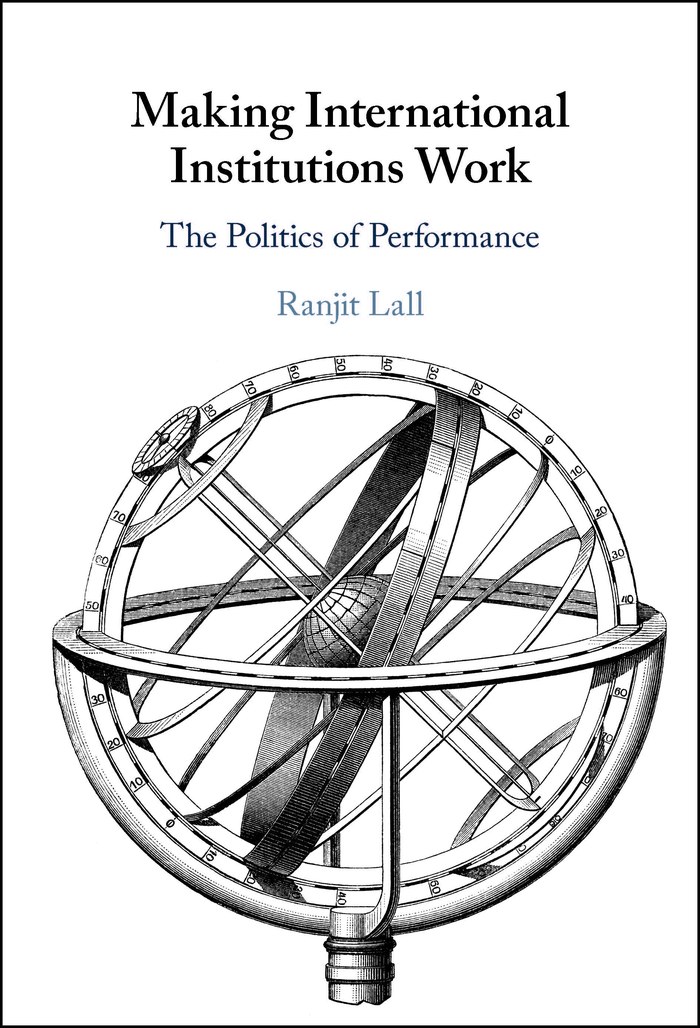
Making International Institutions Work: The Politics of Performance
Cambridge University Press, 2023
Publisher PDF DOIAbstract
International institutions are essential for tackling many of the most urgent challenges facing the world, from pandemics to humanitarian crises, yet we know little about when they succeed, when they fail, and why. This book proposes a new theory of institutional performance and tests it using a diverse array of sources, including the most comprehensive dataset on the topic. Challenging popular characterizations of international institutions as 'runaway bureaucracies,' Ranjit Lall argues that the most serious threat to performance comes from the pursuit of narrow political interests by states – paradoxically, the same actors who create and give purpose to institutions. The discreet operational processes through which international bureaucrats cultivate and sustain autonomy vis-à-vis governments, he contends, are critical to making institutions 'work.' The findings enhance our understanding of international cooperation, public goods, and organizational behavior while offering practical lessons to policymakers, NGOs, businesses, and citizens interested in improving institutional effectiveness.
BibTeX
@book{lall2023cup,
  theme={coop},
  abbr={CUP},
  bibtex_show={true},
  title={Making International Institutions Work: The Politics of Performance},
  abstract={International institutions are essential for tackling many of the most urgent challenges facing the world, from pandemics to humanitarian crises, yet we know little about when they succeed, when they fail, and why. This book proposes a new theory of institutional performance and tests it using a diverse array of sources, including the most comprehensive dataset on the topic. Challenging popular characterizations of international institutions as 'runaway bureaucracies,' Ranjit Lall argues that the most serious threat to performance comes from the pursuit of narrow political interests by states – paradoxically, the same actors who create and give purpose to institutions. The discreet operational processes through which international bureaucrats cultivate and sustain autonomy vis-à-vis governments, he contends, are critical to making institutions 'work.' The findings enhance our understanding of international cooperation, public goods, and organizational behavior while offering practical lessons to policymakers, NGOs, businesses, and citizens interested in improving institutional effectiveness.},
  author={Lall, Ranjit},
  year={2023},
  doi={10.1017/9781009216265},
  url={https://www.cambridge.org/core/books/making-international-institutions-work/2B354270D50B9471D04529CD8D5C98F7},
  html={https://www.cambridge.org/core/books/making-international-institutions-work/2B354270D50B9471D04529CD8D5C98F7},
  publisher={Cambridge University Press},
  pdf={Lall 2023 CUP.pdf},
  location={Cambridge \& New York},
  pagetotal={412},
  cv_note1={Reviewed in <em>Governance</em>, <em>International Affairs</em>, <em>International Organizations Law Review</em>, <em>International Studies Review</em>, <em>Perspectives on Politics</em>, <em>Political Science Quarterly</em>, and the <em>Review of International Organizations</em>.},
  selected={false}
}
Articles, conference proceedings, and book chapters
17 items
Forthcoming
-
APSR
The Political Economy of Artificial Intelligence: Evidence from Western Europe
Conditionally accepted, American Political Science Review
SocArXiv preprint CTS Working Paper 2026-01Abstract
While advances in artificial intelligence (AI) are feared to bring about widespread job losses, workers highly exposed to the technology tend to anticipate productivity-driven improvements in their earnings and employment prospects. I argue that this paradox has important political economy implications: if labor complementarities are expected to outweigh substitution effects—raising income without commensurately intensifying employment risks—exposure to AI should weaken rather than strengthen support for redistributive policies and their political advocates. I test this argument using a combination of observational and original experimental data from Western Europe, finding that occupation-level AI exposure is negatively associated with support for redistribution, the left, and the (increasingly pro-welfare) populist right but positively associated with support for the mainstream right. The results enhance our understanding of the political economy of digitalization, suggesting a discrepancy between the perceived distributional consequences of AI and earlier automation technologies that have primarily displaced labor.
BibTeX
@article{lall2026ai, theme={tech}, abbr={APSR}, bibtex_show={true}, title={The Political Economy of Artificial Intelligence: Evidence from Western Europe}, author={Lall, Ranjit}, journal={American Political Science Review}, year={2026}, note={Conditionally accepted, <em>American Political Science Review</em>}, abstract={While advances in artificial intelligence (AI) are feared to bring about widespread job losses, workers highly exposed to the technology tend to anticipate productivity-driven improvements in their earnings and employment prospects. I argue that this paradox has important political economy implications: if labor complementarities are expected to outweigh substitution effects—raising income without commensurately intensifying employment risks—exposure to AI should weaken rather than strengthen support for redistributive policies and their political advocates. I test this argument using a combination of observational and original experimental data from Western Europe, finding that occupation-level AI exposure is negatively associated with support for redistribution, the left, and the (increasingly pro-welfare) populist right but positively associated with support for the mainstream right. The results enhance our understanding of the political economy of digitalization, suggesting a discrepancy between the perceived distributional consequences of AI and earlier automation technologies that have primarily displaced labor.}, html={https://osf.io/preprints/socarxiv/vmgdj_v1}, html_label={SocArXiv preprint}, link2={https://www.cts-oxford.org/working-papers/}, link2_label={CTS Working Paper 2026-01}, url={https://osf.io/preprints/socarxiv/vmgdj_v1} } -
NeurIPS
PAIR-CI: Calibrated Conditional Independence Testing for Causal Discovery with Incomplete Data
Forthcoming, Advances in Neural Information Processing Systems (NeurIPS 2026)
arXiv preprint PDFAbstract
The standard constraint-based paradigm for causal discovery with incomplete data—impute first, test second—is frequently miscalibrated: any consistent conditional independence (CI) test rejects a true null with probability approaching 1 when imputation error induces spurious conditional dependence. We introduce PAIR-CI, a nonparametric CI test that restores calibration by integrating multiple imputation directly into the inferential procedure via a paired permutation design. PAIR-CI compares cross-validated models that include and exclude the candidate variable while receiving the same imputed conditioning set, forcing imputation error to cancel in their loss difference rather than contaminate the test statistic. A provably consistent variance estimator jointly accounts for uncertainty arising from cross-validation and multiple imputation—to our knowledge, the first formal unification of these two inferential frameworks. In simulations, existing imputation-based CI tests exhibit false positive rates of 28–45% when data are missing not at random (MNAR), whereas PAIR-CI averages below the nominal 5% level across data-generating processes and missingness mechanisms. These gains are largest in nonlinear settings and grow with causal graph size: when integrated into the PC algorithm, PAIR-CI reduces structural Hamming distance by 8% on 10-variable nonlinear graphs, 15% on 30-variable equivalents, and up to 44% on the 56-variable HAILFINDER network, with stable performance in all settings.
BibTeX
@inproceedings{robinson2026pairci,
  theme={methods},
  abbr={NeurIPS},
  bibtex_show={true},
  title={PAIR-CI: Calibrated Conditional Independence Testing for Causal Discovery with Incomplete Data},
  author={Robinson, Thomas S. and Ranjit Lall},
  year={2026},
  booktitle={Advances in Neural Information Processing Systems (NeurIPS 2026)},
  note={Forthcoming, <em>Advances in Neural Information Processing Systems</em> (NeurIPS 2026)},
  abstract={The standard constraint-based paradigm for causal discovery with incomplete data—impute first, test second—is frequently miscalibrated: any consistent conditional independence (CI) test rejects a true null with probability approaching 1 when imputation error induces spurious conditional dependence. We introduce PAIR-CI, a nonparametric CI test that restores calibration by integrating multiple imputation directly into the inferential procedure via a paired permutation design. PAIR-CI compares cross-validated models that include and exclude the candidate variable while receiving the same imputed conditioning set, forcing imputation error to cancel in their loss difference rather than contaminate the test statistic. A provably consistent variance estimator jointly accounts for uncertainty arising from cross-validation and multiple imputation—to our knowledge, the first formal unification of these two inferential frameworks. In simulations, existing imputation-based CI tests exhibit false positive rates of 28–45% when data are missing not at random (MNAR), whereas PAIR-CI averages below the nominal 5% level across data-generating processes and missingness mechanisms. These gains are largest in nonlinear settings and grow with causal graph size: when integrated into the PC algorithm, PAIR-CI reduces structural Hamming distance by 8% on 10-variable nonlinear graphs, 15% on 30-variable equivalents, and up to 44% on the 56-variable HAILFINDER network, with stable performance in all settings.},
  html={https://arxiv.org/abs/2605.04838},
  html_label={arXiv preprint},
  link2={https://arxiv.org/pdf/2605.04838},
  link2_label={PDF},
  url={https://arxiv.org/abs/2605.04838}
}
2026
-
CPS
Right-Wing Populism and the COVID-19 Shock: Evidence from Early Superspreader Events
Comparative Political Studies, 1–44, 2026
Publisher PDF DOIAbstract
Can public health shocks boost right-wing populism? We investigate how the onset of the COVID-19 pandemic impacted support for populists in Western Europe, an unresolved debate on which surprisingly little systematic evidence exists. Building on theories of populist mobilization in societal crises, we hypothesize a positive aggregate effect driven by declining confidence in public institutions, intensifying hostility toward outgroups, and opposition to government restrictions. Exploiting variation in local COVID-19 incidence stemming from the idiosyncratic timing of early superspreader events, we find a rise in online engagement with populists in regions with higher infection rates. We document a similar increase in populist support in the 2020 French municipal elections and in representative British and Dutch survey data. These varied sources corroborate our three posited mechanisms while casting doubt on possible alternative economic, social, and psychological channels. The findings broaden our understanding of the types of societal shocks that foster extreme politics.
BibTeX
@article{lall2026cps, abbr={CPS}, bibtex_show={true}, title={Right-Wing Populism and the COVID-19 Shock: Evidence from Early Superspreader Events}, abstract={Can public health shocks boost right-wing populism? We investigate how the onset of the COVID-19 pandemic impacted support for populists in Western Europe, an unresolved debate on which surprisingly little systematic evidence exists. Building on theories of populist mobilization in societal crises, we hypothesize a positive aggregate effect driven by declining confidence in public institutions, intensifying hostility toward outgroups, and opposition to government restrictions. Exploiting variation in local COVID-19 incidence stemming from the idiosyncratic timing of early superspreader events, we find a rise in online engagement with populists in regions with higher infection rates. We document a similar increase in populist support in the 2020 French municipal elections and in representative British and Dutch survey data. These varied sources corroborate our three posited mechanisms while casting doubt on possible alternative economic, social, and psychological channels. The findings broaden our understanding of the types of societal shocks that foster extreme politics.}, author={Lall, Ranjit and Thomas R. Davidson and Felix Hagemeister}, journal={Comparative Political Studies}, pages={1--44}, year={2026}, doi={10.1177/00104140261448406}, html={https://journals.sagepub.com/doi/10.1177/00104140261448406}, pdf={Lall, Davidson, and Hagemeister 2026 CPS.pdf}, selected={true} } -
APSR
Consequences of the Black Sea Slave Trade: Long-Run Development in Eastern Europe
American Political Science Review 120(3), 1127–1149, 2026
Publisher PDF DOIAbstract
We investigate the developmental consequences of slave-raiding in Eastern Europe, the largest source of slaves in the early modern world after West Africa. Drawing on a wide-ranging new dataset, we estimate that at least five million people were captured from hundreds of locations across Eastern Europe between the fifteenth and eighteenth centuries. We hypothesize that, over time, raids encouraged an economically advantageous process of defensive state-building linked to raided societies’ resistance to and lack of integration into the slave trade. Using difference-in-differences and instrumental variables strategies, we find that exposure to raids is positively associated with long-run urban growth and related indicators of demographic and commercial development. Consistent with our posited mechanism, raided areas constructed more robust defensive infrastructures and attained higher levels of military, administrative, and fiscal capacity. Our findings suggest that the structure of slave production conditions its developmental legacies, cautioning against drawing generalizations from the African context.
BibTeX
@article{charnysh2026apsr, theme={dev}, abbr={APSR}, bibtex_show={true}, title={Consequences of the Black Sea Slave Trade: Long-Run Development in Eastern Europe}, abstract={We investigate the developmental consequences of slave-raiding in Eastern Europe, the largest source of slaves in the early modern world after West Africa. Drawing on a wide-ranging new dataset, we estimate that at least five million people were captured from hundreds of locations across Eastern Europe between the fifteenth and eighteenth centuries. We hypothesize that, over time, raids encouraged an economically advantageous process of defensive state-building linked to raided societies’ resistance to and lack of integration into the slave trade. Using difference-in-differences and instrumental variables strategies, we find that exposure to raids is positively associated with long-run urban growth and related indicators of demographic and commercial development. Consistent with our posited mechanism, raided areas constructed more robust defensive infrastructures and attained higher levels of military, administrative, and fiscal capacity. Our findings suggest that the structure of slave production conditions its developmental legacies, cautioning against drawing generalizations from the African context.}, author={Charnysh, Volha and Ranjit Lall}, journal={American Political Science Review}, volume={120}, number={3}, pages={1127--1149}, year={2026}, doi={10.1017/S0003055426101439}, url={https://www.cambridge.org/core/journals/american-political-science-review/article/consequences-of-the-black-sea-slave-trade-longrun-development-in-eastern-europe/E6074298B3135E3B858CF9E64BE45F99#article}, html={https://www.cambridge.org/core/journals/american-political-science-review/article/consequences-of-the-black-sea-slave-trade-longrun-development-in-eastern-europe/E6074298B3135E3B858CF9E64BE45F99#article}, pdf={Charnysh and Lall 2026 APSR.pdf}, coverage1={https://politicalsciencenow.com/could-slave-raids-have-strengthened-states-evidence-from-eastern-europe/}, coverage1_label={Political Science Now, by Deborah Saki}, publisher={Cambridge University Press}, award1={David Brian Robertson Best Paper Award, Politics and History Section, American Political Science Association, 2025}, award1_url={https://www.politics.ox.ac.uk/news/ranjit-lall-wins-apsa-award-paper-slave-raiding-eastern-europe}, selected={true} }Written about in Political Science Now, by Deborah Saki
2025
-
BJPS
Varieties of Anxieties: Disaggregating Emotion and Voting Behavior in the COVID-19 Era
British Journal of Political Science 55, e87, 2025
Publisher PDF DOIAbstract
How does anxiety influence voting behavior? Whereas anxiety is usually treated as a uni- dimensional emotion, we highlight the multiplicity of socially contingent forms it can assume in response to societal threats. Different anxieties, we posit, can create distinct axes of political competition along which anxious voters exhibit widely varying preferences. We illustrate our argument with unique observational and experimental survey data from Spain’s COVID-19 crisis, showing that individuals anxious about the pandemic’s health consequences favored parties advocating stringent lockdown restrictions, whereas indi- viduals anxious about its economic disruption preferred parties opposing such measures. Analyzing municipality-level results from Madrid’s 2021 regional election, we addition- ally provide evidence that COVID-19 boosted support for pro-lockdown parties in areas more exposed to its health effects and support for anti-lockdown parties in areas more ex- posed to its economic impact. Our findings point to the importance of disaggregating complex emotional states for understanding the determinants of voting behavior.
BibTeX
@article{lall2025bjps, abbr={BJPS}, bibtex_show={true}, title={Varieties of Anxieties: Disaggregating Emotion and Voting Behavior in the COVID-19 Era}, abstract={How does anxiety influence voting behavior? Whereas anxiety is usually treated as a uni- dimensional emotion, we highlight the multiplicity of socially contingent forms it can assume in response to societal threats. Different anxieties, we posit, can create distinct axes of political competition along which anxious voters exhibit widely varying preferences. We illustrate our argument with unique observational and experimental survey data from Spain’s COVID-19 crisis, showing that individuals anxious about the pandemic’s health consequences favored parties advocating stringent lockdown restrictions, whereas indi- viduals anxious about its economic disruption preferred parties opposing such measures. Analyzing municipality-level results from Madrid’s 2021 regional election, we addition- ally provide evidence that COVID-19 boosted support for pro-lockdown parties in areas more exposed to its health effects and support for anti-lockdown parties in areas more ex- posed to its economic impact. Our findings point to the importance of disaggregating complex emotional states for understanding the determinants of voting behavior.}, author={Lall, Ranjit and Vilalta, David}, journal={British Journal of Political Science}, pages={e87}, volume={55}, year={2025}, doi={10.1017/S0007123425000377}, html={https://www.cambridge.org/core/journals/british-journal-of-political-science/article/varieties-of-anxieties-disaggregating-emotion-and-voting-behaviour-in-the-covid19-era/8EBEA0DED6B4255C9D00B07ACF22F47A}, url={https://www.cambridge.org/core/journals/british-journal-of-political-science/article/varieties-of-anxieties-disaggregating-emotion-and-voting-behaviour-in-the-covid19-era/8EBEA0DED6B4255C9D00B07ACF22F47A}, pdf={Lall and Vilalta 2025 BJPS.pdf}, } -
AJPS
Making Global Governance Accountable: Civil Society, States, and the Politics of Reform
American Journal of Political Science 69(1), 96–117, 2025
Publisher PDF DOIAbstract
Recent decades have witnessed the adoption of unprecedentedly broad and inclusive accountability mechanisms by many major international institutions, from grievance redress systems to transparency policies. What explains the establishment of these mechanisms — and why have only some institutions embraced them? I argue that adoption is more likely when member states, in particular the most powerful, face "bottom-up" pressures for accountability from dense transnational civil society networks — networks with the capacity to build leverage through agenda setting, coalition building, and advocacy strategies — and when institutions perform governance tasks that are costly to monitor. Analysis of a rich new dataset shows that adoption is positively related to the density of international nongovernmental organizations in an institution’s issue area — including only those based in powerful member countries — and that this relationship is stronger when governance tasks entail high monitoring costs. Statistical tests are complemented by qualitative evidence from interviews and other primary sources.
BibTeX
@article{lall2025ajps,
  theme={coop},
  abbr={AJPS},
  bibtex_show={true},
  title={Making Global Governance Accountable: Civil Society, States, and the Politics of Reform},
  abstract={Recent decades have witnessed the adoption of unprecedentedly broad and inclusive accountability mechanisms by many major international institutions, from grievance redress systems to transparency policies. What explains the establishment of these mechanisms — and why have only some institutions embraced them? I argue that adoption is more likely when member states, in particular the most powerful, face "bottom-up" pressures for accountability from dense transnational civil society networks — networks with the capacity to build leverage through agenda setting, coalition building, and advocacy strategies — and when institutions perform governance tasks that are costly to monitor. Analysis of a rich new dataset shows that adoption is positively related to the density of international nongovernmental organizations in an institution’s issue area — including only those based in powerful member countries — and that this relationship is stronger when governance tasks entail high monitoring costs. Statistical tests are complemented by qualitative evidence from interviews and other primary sources.},
  author={Lall, Ranjit},
  journal={American Journal of Political Science},
  volume={69},
  number={1},
  pages={96--117},
  year={2025},
  doi={10.1111/ajps.12824},
  url={https://onlinelibrary.wiley.com/doi/10.1111/ajps.12824},
  html={https://onlinelibrary.wiley.com/doi/10.1111/ajps.12824},
  pdf={Lall 2025 AJPS.pdf},
  publisher={Wiley Online Library},
  coverage1={https://www.aiddata.org/blog/how-effective-and-accountable-are-international-development-organizations},
  coverage1_label={AidData, by Ranjit Lall},
}
Written about in AidData, by Ranjit Lall
2023
-
JSS
Efficient Multiple Imputation for Diverse Data in Python and R: MIDASpy and rMIDAS
Journal of Statistical Software 107(9), 1–38, 2023
Publisher PDF DOIAbstract
This paper introduces software packages for efficiently imputing missing data using deep learning methods in Python (MIDASpy) and R (rMIDAS). The packages implement a recently developed approach to multiple imputation known as MIDAS, which involves introducing additional missing values into the dataset, attempting to reconstruct these values with a type of unsupervised neural network known as a denoising autoencoder, and using the resulting model to draw imputations of originally missing data. These steps are executed by a fast and flexible algorithm that expands both the quantity and the range of data that can be analyzed with multiple imputation. To help users optimize the algorithm for their particular application, MIDASpy and rMIDAS offer a host of user-friendly tools for calibrating and validating the imputation model. We provide a detailed guide to these functionalities and demonstrate their usage on a large real dataset.
BibTeX
@article{lall2023jss, theme={methods}, abbr={JSS}, bibtex_show={true}, title={Efficient Multiple Imputation for Diverse Data in Python and R: MIDASpy and rMIDAS}, abstract={This paper introduces software packages for efficiently imputing missing data using deep learning methods in Python (MIDASpy) and R (rMIDAS). The packages implement a recently developed approach to multiple imputation known as MIDAS, which involves introducing additional missing values into the dataset, attempting to reconstruct these values with a type of unsupervised neural network known as a denoising autoencoder, and using the resulting model to draw imputations of originally missing data. These steps are executed by a fast and flexible algorithm that expands both the quantity and the range of data that can be analyzed with multiple imputation. To help users optimize the algorithm for their particular application, MIDASpy and rMIDAS offer a host of user-friendly tools for calibrating and validating the imputation model. We provide a detailed guide to these functionalities and demonstrate their usage on a large real dataset.}, author={Lall, Ranjit and Robinson, Thomas}, journal={Journal of Statistical Software}, pages={1--38}, year={2023}, volume={107}, number={9}, doi={10.18637/jss.v107.i09}, url={https://www.jstatsoft.org/article/view/v107i09}, html={https://www.jstatsoft.org/article/view/v107i09}, pdf={Lall and Robinson 2023 JSS.pdf}, } -
AJPS
When Does Transparency Improve Institutional Performance? Evidence from 20,000 Projects in 183 Countries
American Journal of Political Science 67(4), 1096–1116, 2023
Publisher PDF DOIAbstract
Access to information (ATI) policies are often praised for strengthening transparency, accountability, and trust in public institutions, yet evidence that they improve institutional performance is mixed. We argue that an important impediment to the effective operation of such policies is the failure of bureaucrats to comply with information requests that could expose poor performance. Analyzing a new data set on the performance of approximately 20,000 aid projects financed by 12 donor agencies in 183 countries, we find that enforcement matters: the adoption of ATI policies by agencies is associated with better project outcomes when these policies include independent appeals processes for denied information requests but with no improvement when they do not. We also recover evidence that project staff adjust their behavior in anticipation of ATI appeals, and that the performance dividends of appeals processes increase when bottom-up collective action is easier and mechanisms of project oversight are weak.
BibTeX
@article{honig2023ajps,
  theme={dev},
  abbr={AJPS},
  bibtex_show={true},
  title={When Does Transparency Improve Institutional Performance? Evidence from 20,000 Projects in 183 Countries},
  abstract={Access to information (ATI) policies are often praised for strengthening transparency, accountability, and trust in public institutions, yet evidence that they improve institutional performance is mixed. We argue that an important impediment to the effective operation of such policies is the failure of bureaucrats to comply with information requests that could expose poor performance. Analyzing a new data set on the performance of approximately 20,000 aid projects financed by 12 donor agencies in 183 countries, we find that enforcement matters: the adoption of ATI policies by agencies is associated with better project outcomes when these policies include independent appeals processes for denied information requests but with no improvement when they do not. We also recover evidence that project staff adjust their behavior in anticipation of ATI appeals, and that the performance dividends of appeals processes increase when bottom-up collective action is easier and mechanisms of project oversight are weak.},
  author={Honig, Dan and Lall, Ranjit and Parks, Bradley C.},
  journal={American Journal of Political Science},
  volume={67},
  number={4},
  pages={1096--1116},
  year={2023},
  doi={10.1111/ajps.12698},
  url={https://onlinelibrary.wiley.com/doi/10.1111/ajps.12698},
  html={https://onlinelibrary.wiley.com/doi/10.1111/ajps.12698},
  pdf={Honig, Lall, and Parks 2023 AJPS.pdf},
  publisher={Wiley Online Library},
  coverage1={https://www.aiddata.org/blog/testing-transparencys-benefits-when-does-it-truly-improve-how-institutions-perform},
  coverage1_label={AidData, by Sarina Patterson},
  coverage2={https://www.effectivecooperation.org/AidDataBlog},
  coverage2_label={Global Partnership for Effective Development Co-operation},
}
Written about in AidData, by Sarina Patterson, Global Partnership for Effective Development Co-operation
2022
-
PA
The MIDAS Touch: Accurate and Scalable Missing-Data Imputation with Deep Learning
Political Analysis 30(2), 179–196, 2022
Publisher PDF DOIAbstract
Principled methods for analyzing missing values, based chiefly on multiple imputation, have become increasingly popular yet can struggle to handle the kinds of large and complex data that are also becoming common. We propose an accurate, fast, and scalable approach to multiple imputation, which we call MIDAS (Multiple Imputation with Denoising Autoencoders). MIDAS employs a class of unsupervised neural networks known as denoising autoencoders, which are designed to reduce dimensionality by corrupting and attempting to reconstruct a subset of data. We repurpose denoising autoencoders for multiple imputation by treating missing values as an additional portion of corrupted data and drawing imputations from a model trained to minimize the reconstruction error on the originally observed portion. Systematic tests on simulated as well as real social science data, together with an applied example involving a large-scale electoral survey, illustrate MIDAS’s accuracy and efficiency across a range of settings. We provide open-source software for implementing MIDAS.
BibTeX
@article{lall2022pa,
  theme={methods},
  abbr={PA},
  bibtex_show={true},
  title={The MIDAS Touch: Accurate and Scalable Missing-Data Imputation with Deep Learning},
  abstract={Principled methods for analyzing missing values, based chiefly on multiple imputation, have become increasingly popular yet can struggle to handle the kinds of large and complex data that are also becoming common. We propose an accurate, fast, and scalable approach to multiple imputation, which we call MIDAS (Multiple Imputation with Denoising Autoencoders). MIDAS employs a class of unsupervised neural networks known as denoising autoencoders, which are designed to reduce dimensionality by corrupting and attempting to reconstruct a subset of data. We repurpose denoising autoencoders for multiple imputation by treating missing values as an additional portion of corrupted data and drawing imputations from a model trained to minimize the reconstruction error on the originally observed portion. Systematic tests on simulated as well as real social science data, together with an applied example involving a large-scale electoral survey, illustrate MIDAS’s accuracy and efficiency across a range of settings. We provide open-source software for implementing MIDAS.},
  author={Lall, Ranjit and Robinson, Thomas},
  journal={Political Analysis},
  pages={179–196},
  volume={30},
  number={2},
  year={2022},
  doi={10.1017/pan.2020.49},
  url={https://www.cambridge.org/core/journals/political-analysis/article/abs/midas-touch-accurate-and-scalable-missingdata-imputation-with-deep-learning/5007854F57E88AF16D69BCCA4C5AF1FF},
  html={https://www.cambridge.org/core/journals/political-analysis/article/abs/midas-touch-accurate-and-scalable-missingdata-imputation-with-deep-learning/5007854F57E88AF16D69BCCA4C5AF1FF},
  pdf={Lall and Robinson 2022 PA.pdf},
  publisher={Cambridge University Press},
  coverage1={https://statmodeling.stat.columbia.edu/2018/01/10/python-program-multivariate-missing-data-imputation-works-large-datasets/},
  coverage1_label={Statistical Modeling, Causal Inference, and Social Science (Andrew Gelman)},
}
Written about in Statistical Modeling, Causal Inference, and Social Science (Andrew Gelman)
2021
-
ISQ
The Financial Consequences of Rating International Institutions: Competition, Collaboration, and the Politics of Assessment
International Studies Quarterly 65(2), 343–359, 2021
Publisher PDF DOIAbstract
The past 15 years have witnessed a striking trend in global governance: the creation of comparative indicators of the performance of international institutions by donor states seeking to allocate their resources more efficiently. Interestingly, however, not all highly rated institutions have been "rewarded" with increased contributions, while not all poorly rated institutions have been "punished" with funding cuts or freezes. I argue that the financial impact of performance indicators is contingent upon the relationshipbetween institutions and other actors within their environment, with stronger effects occurring when institutions (1) are subject to a higher degree of resource competition and (2) possess deeper and more extensive operational alliances with actors above and below the state. I test the argument using a mixed-methods strategy that draws on a variety of original sources, including key informant interviews and a new dataset covering fifty-three institutions over the period 2000–2016. The findings enhance our understanding of when and why comparative performance indicators influence resource flows to assessed entities.
BibTeX
@article{lall2021isq,
  theme={coop},
  abbr={ISQ},
  bibtex_show={true},
  title={The Financial Consequences of Rating International Institutions: Competition, Collaboration, and the Politics of Assessment},
  abstract={The past 15 years have witnessed a striking trend in global governance: the creation of comparative indicators of the performance of international institutions by donor states seeking to allocate their resources more efficiently. Interestingly, however, not all highly rated institutions have been "rewarded" with increased contributions, while not all poorly rated institutions have been "punished" with funding cuts or freezes. I argue that the financial impact of performance indicators is contingent upon the relationshipbetween institutions and other actors within their environment, with stronger effects occurring when institutions (1) are subject to a higher degree of resource competition and (2) possess deeper and more extensive operational alliances with actors above and below the state. I test the argument using a mixed-methods strategy that draws on a variety of original sources, including key informant interviews and a new dataset covering fifty-three institutions over the period 2000–2016. The findings enhance our understanding of when and why comparative performance indicators influence resource flows to assessed entities.},
  author={Lall, Ranjit},
  journal={International Studies Quarterly},
  volume={65},
  number={2},
  pages={343--359},
  year={2021},
  doi={10.1093/isq/sqaa082},
  url={https://academic.oup.com/isq/article-abstract/65/2/343/5999077},
  html={https://academic.oup.com/isq/article-abstract/65/2/343/5999077},
  pdf={Lall 2021 ISQ.pdf},
  publisher={Oxford University Press},
}
2020
-
CUP
Assessing International Organizations: Competition, Collaboration, and the Politics of Funding
In The Power of Global Performance Indicators, Cambridge University Press, 2020
Publisher PDF DOIBibTeX
@incollection{lall2020cup,
  abbr={CUP},
  bibtex_show={true},
  title={Assessing International Organizations: Competition, Collaboration, and the Politics of Funding},
  author={Lall, Ranjit},
  booktitle={The Power of Global Performance Indicators},
  editor={Kelley, Judith G. and Beth A. Simmons},
  pages={300--338},
  doi={10.1017/9781108763493.011},
  url={https://www.cambridge.org/core/books/power-of-global-performance-indicators/assessing-international-organizations/C8E47ACB33BE9C68D9E8FAB50A8E97DF},
  html={https://www.cambridge.org/core/books/power-of-global-performance-indicators/assessing-international-organizations/C8E47ACB33BE9C68D9E8FAB50A8E97DF},
  year={2020},
  publisher={Cambridge University Press},
  address={New York},
  pdf={Lall 2020 CUP Chapter.pdf}
}
2017
-
CPS
The Missing Dimension of the Political Resource Curse Debate
Comparative Political Studies 50(10), 1291–1324, 2017
Publisher PDF DOIAbstract
Given the methodological sophistication of the debate over the ``political resource curse'' — the purported negative relationship between natural resource wealth (in particular oil wealth) and democracy — it is surprising that scholars have not paid more attention to the basic statistical issue of how to deal with missing data. This article highlights the problems caused by the most common strategy for analyzing missing data in the political resource curse literature — listwise deletion — and investigates how addressing such problems through the best-practice technique of multiple imputation affects empirical results. I find that multiple imputation causes the results of a number of influential recent studies to converge on a key common finding: A political resource curse does exist, but only since the widespread nationalization of petroleum industries in the 1970s. This striking finding suggests that much of the controversy over the political resource curse has been caused by a neglect of missing-data issues.
BibTeX
@article{lall2017cps, bibtex_show={true}, abbr={CPS}, title={The Missing Dimension of the Political Resource Curse Debate}, abstract={Given the methodological sophistication of the debate over the ``political resource curse'' — the purported negative relationship between natural resource wealth (in particular oil wealth) and democracy — it is surprising that scholars have not paid more attention to the basic statistical issue of how to deal with missing data. This article highlights the problems caused by the most common strategy for analyzing missing data in the political resource curse literature — listwise deletion — and investigates how addressing such problems through the best-practice technique of multiple imputation affects empirical results. I find that multiple imputation causes the results of a number of influential recent studies to converge on a key common finding: A political resource curse does exist, but only since the widespread nationalization of petroleum industries in the 1970s. This striking finding suggests that much of the controversy over the political resource curse has been caused by a neglect of missing-data issues.}, author={Lall, Ranjit}, journal={Comparative Political Studies}, volume={50}, number={10}, pages={1291--1324}, year={2017}, doi={10.1177/0010414016666861}, url={https://journals.sagepub.com/doi/10.1177/0010414016666861}, html={https://journals.sagepub.com/doi/full/10.1177/0010414016666861}, pdf={Lall 2017 CPS.pdf}, publisher={Sage Publications Sage CA: Los Angeles, CA} } -
IO
Beyond Institutional Design: Explaining the Performance of International Organizations
International Organization 71(2), 245–280, 2017
Publisher PDF DOIAbstract
International organizations (IOs) have long been a central focus of scholarship in international relations, yet we know remarkably little about their performance. This article offers an explanation for differences in the performance of IOs and tests it using the first quantitative data set on the topic. I argue that the primary obstacle to effective institutional performance is not deviant behavior by IO officials — as conventional "rogue-agency" analyses suggest — but the propensity of states to use IOs to promote narrow national interests rather than broader organizational objectives. IOs that enjoy policy autonomy vis-à-vis states will thus exhibit higher levels of performance. However, in the international context policy autonomy cannot be guaranteed by institutional design. Instead, it is a function of (1) the existence of (certain types of) institutionalized alliances between IOs and actors above and below the state; and (2) the technical complexity of IO activities. I provide empirical evidence for the argument by constructing and analyzing a cross-sectional data set on IO performance — based in part on a new wave of official government evaluations of IOs and in part on an original survey of IO staff — and conducting a comparative case study in the realm of global food security.
BibTeX
@article{lall2017io,
  theme={coop},
  abbr={IO},
  bibtex_show={true},
  title={Beyond Institutional Design: Explaining the Performance of International Organizations},
  abstract={International organizations (IOs) have long been a central focus of scholarship in international relations, yet we know remarkably little about their performance. This article offers an explanation for differences in the performance of IOs and tests it using the first quantitative data set on the topic. I argue that the primary obstacle to effective institutional performance is not deviant behavior by IO officials — as conventional "rogue-agency" analyses suggest — but the propensity of states to use IOs to promote narrow national interests rather than broader organizational objectives. IOs that enjoy policy autonomy vis-à-vis states will thus exhibit higher levels of performance. However, in the international context policy autonomy cannot be guaranteed by institutional design. Instead, it is a function of (1) the existence of (certain types of) institutionalized alliances between IOs and actors above and below the state; and (2) the technical complexity of IO activities. I provide empirical evidence for the argument by constructing and analyzing a cross-sectional data set on IO performance — based in part on a new wave of official government evaluations of IOs and in part on an original survey of IO staff — and conducting a comparative case study in the realm of global food security.},
  author={Lall, Ranjit},
  journal={International Organization},
  volume={71},
  number={2},
  pages={245--280},
  year={2017},
  doi={10.1017/S0020818317000066},
  url={https://www.cambridge.org/core/journals/international-organization/article/abs/beyond-institutional-design-explaining-the-performance-of-international-organizations/EA20B0FA16A6AC9AABAFC4E27DCC605B},
  html={https://www.cambridge.org/core/journals/international-organization/article/abs/beyond-institutional-design-explaining-the-performance-of-international-organizations/EA20B0FA16A6AC9AABAFC4E27DCC605B},
  pdf={Lall 2017 IO.pdf},
  publisher={Cambridge University Press}
}
2016
-
PA
How Multiple Imputation Makes a Difference
Political Analysis 24(4), 414–433, 2016
Publisher PDF DOIAbstract
Political scientists increasingly recognize that multiple imputation represents a superior strategy for analyzing missing data to the widely used method of listwise deletion. However, there has been little systematic investigation of how multiple imputation affects existing empirical knowledge in the discipline. This article presents the first large-scale examination of the empirical effects of substituting multiple imputation for listwise deletion in political science. The examination focuses on research in the major subfield of comparative and international political economy (CIPE) as an illustrative example. Specifically, I use multiple imputation to reanalyze the results of almost every quantitative CIPE study published during a recent five-year period in International Organization and World Politics, two of the leading subfield journals in CIPE. The outcome is striking: in almost half of the studies, key results "disappear" (by conventional statistical standards) when reanalyzed.
BibTeX
@article{lall2016pa,
  theme={methods},
  abbr={PA},
  bibtex_show={true},
  title={How Multiple Imputation Makes a Difference},
  abstract={Political scientists increasingly recognize that multiple imputation represents a superior strategy for analyzing missing data to the widely used method of listwise deletion. However, there has been little systematic investigation of how multiple imputation affects existing empirical knowledge in the discipline. This article presents the first large-scale examination of the empirical effects of substituting multiple imputation for listwise deletion in political science. The examination focuses on research in the major subfield of comparative and international political economy (CIPE) as an illustrative example. Specifically, I use multiple imputation to reanalyze the results of almost every quantitative CIPE study published during a recent five-year period in International Organization and World Politics, two of the leading subfield journals in CIPE. The outcome is striking: in almost half of the studies, key results "disappear" (by conventional statistical standards) when reanalyzed.},
  author={Lall, Ranjit},
  journal={Political Analysis},
  volume={24},
  number={4},
  pages={414--433},
  year={2016},
  doi={10.1093/pan/mpw020},
  url={https://www.cambridge.org/core/journals/political-analysis/article/how-multiple-imputation-makes-a-difference/8C6616B679EF8F3EB0041B1BC88EEBB9},
  html={https://www.cambridge.org/core/journals/political-analysis/article/how-multiple-imputation-makes-a-difference/8C6616B679EF8F3EB0041B1BC88EEBB9},
  pdf={Lall 2016 PA.pdf},
  publisher={Cambridge University Press}
}
2015
-
RegGov
Timing as a Source of Regulatory Influence: A Technical Elite Network Analysis of Global Finance
Regulation & Governance 9(2), 125–143, 2015
Publisher PDF DOIAbstract
Rules governing the international financial system are the subject of some of the most intense distributional battles waged in any area of global governance. Who wins and who loses such battles – and why? I develop a novel analytical framework – technical elite network (TEN) theory – which explains the widely varying levels of influence that stakeholders enjoy over global financial standards. TEN theory draws attention to how issue-specific characteristics of international finance – in particular, its highly technical and complex nature – shape the distributional consequences of global regulatory processes. It posits that such characteristics influence distributional outcomes by (i) affecting who claims first-mover position and, thus, sets the agenda in global financial rulemaking, and (ii) ensuring that proposals made by first movers are increasingly difficult to alter at later stages of rulemaking. I provide empirical evidence for the theory by examining two regulatory regimes that are central to the efficiency and stability of the global financial system: the Basel Committee on Banking Supervision and the International Accounting Standards Board.
BibTeX
@article{lall2015rg,
  abbr={RegGov},
  bibtex_show={true},
  title={Timing as a Source of Regulatory Influence: A Technical Elite Network Analysis of Global Finance},
  abstract={Rules governing the international financial system are the subject of some of the most intense distributional battles waged in any area of global governance. Who wins and who loses such battles – and why? I develop a novel analytical framework – technical elite network (TEN) theory – which explains the widely varying levels of influence that stakeholders enjoy over global financial standards. TEN theory draws attention to how issue-specific characteristics of international finance – in particular, its highly technical and complex nature – shape the distributional consequences of global regulatory processes. It posits that such characteristics influence distributional outcomes by (i) affecting who claims first-mover position and, thus, sets the agenda in global financial rulemaking, and (ii) ensuring that proposals made by first movers are increasingly difficult to alter at later stages of rulemaking. I provide empirical evidence for the theory by examining two regulatory regimes that are central to the efficiency and stability of the global financial system: the Basel Committee on Banking Supervision and the International Accounting Standards Board.},
  author={Lall, Ranjit},
  journal={Regulation \& Governance},
  volume={9},
  number={2},
  pages={125--143},
  year={2015},
  doi={10.1111/rego.12050},
  url={https://onlinelibrary.wiley.com/doi/10.1111/rego.12050},
  html={https://onlinelibrary.wiley.com/doi/full/10.1111/rego.12050},
  pdf={Lall 2015 RegGov.pdf},
  publisher={Wiley Online Library}
}
2012
-
RIPE
From Failure to Failure: The Politics of International Banking Regulation
Review of International Political Economy 19(4), 609–638, 2012
Publisher PDF DOIAbstract
It is now clear that Basel III, a much discussed set of proposals to govern the international banking system drawn up by the Basel Committee on Banking Supervision, has fallen far short of its creators' aims. Even more puzzlingly, this is not without precedent. Eleven years ago, partly in response to the Asian financial crisis of 1997, the Basel Committee attempted to overhaul global banking rules in order to enhance the stability of the global financial system. The culmination of its five-year efforts, the Basel II Accord, was abandoned by regulators before ever being fully implemented. In this paper, I ask why Basel II failed to meet the Basel Committee's original objectives and why Basel III has met a similar fate. Drawing on recent work on the politics of global regulation, I present a theoretical framework which emphasizes the importance of timing and sequencing in determining the outcome of rule-making in global finance. The success of this framework in explaining the failure of Basel II and Basel III is an invitation to scholars in the field of International Relations to take `time' seriously as an analytical variable.
BibTeX
@article{lall2012ripe,
  abbr={RIPE},
  bibtex_show={true},
  title={From Failure to Failure: The Politics of International Banking Regulation},
  abstract={It is now clear that Basel III, a much discussed set of proposals to govern the international banking system drawn up by the Basel Committee on Banking Supervision, has fallen far short of its creators' aims. Even more puzzlingly, this is not without precedent. Eleven years ago, partly in response to the Asian financial crisis of 1997, the Basel Committee attempted to overhaul global banking rules in order to enhance the stability of the global financial system. The culmination of its five-year efforts, the Basel II Accord, was abandoned by regulators before ever being fully implemented. In this paper, I ask why Basel II failed to meet the Basel Committee's original objectives and why Basel III has met a similar fate. Drawing on recent work on the politics of global regulation, I present a theoretical framework which emphasizes the importance of timing and sequencing in determining the outcome of rule-making in global finance. The success of this framework in explaining the failure of Basel II and Basel III is an invitation to scholars in the field of International Relations to take `time' seriously as an analytical variable.},
  author={Lall, Ranjit},
  journal={Review of International Political Economy},
  volume={19},
  number={4},
  pages={609--638},
  year={2012},
  doi={10.1080/09692290.2011.603669},
  url={https://www.tandfonline.com/doi/abs/10.1080/09692290.2011.603669},
  html={https://www.tandfonline.com/doi/full/10.1080/09692290.2011.603669?scroll=top&needAccess=true},
  pdf={Lall 2012 RIPE.pdf},
  publisher={Taylor \& Francis}
}
2011
-
PM
Reforming Global Banking Standards: Back to the Future?
In Governing through Standards: Origins, Drivers and Limitations, Palgrave Macmillan, 2011
Publisher PDFBibTeX
@incollection{lall2011pm,
  abbr={PM},
  bibtex_show={true},
  title={Reforming Global Banking Standards: Back to the Future?},
  author={Lall, Ranjit},
  booktitle={Governing through Standards: Origins, Drivers and Limitations},
  editor={Ponte, Stefano and Peter Gibbon and Jakob Vestergaard},
  pages={75--101},
  url={https://www.palgrave.com/gp/book/9780230295407},
  html={https://www.palgrave.com/gp/book/9780230295407},
  year={2011},
  publisher={Palgrave Macmillan},
  address={Basingstoke},
  pdf={Lall 2011 PM Chapter.pdf}
}
Policy reports
7 items
2026
-
AIGI
The Future of the AI Summit Series: One Year Later
Oxford Martin AI Governance Initiative Policy Brief, 2026
Publisher PDFAbstract
A year after The Future of the AI Summit Series (January 2025), the international landscape for AI governance has evolved significantly. The United Nations has established a Global Dialogue on AI Governance, frontier AI capabilities have advanced rapidly, and the AI Summit Series has expanded in both scale and global participation. The Paris (2025) and Delhi (2026) summits demonstrated growing international engagement, leading to the New Delhi Declaration and the announcement of future hosts through 2028. Yet, despite this momentum, the series continues to rely on informal governance structures, host-driven agendas, and an ad hoc secretariat, limiting its long-term policy impact. This update revisits the recommendations of the original memo, assesses progress to date, and argues that the next phase of the Summit Series should focus on institutional maturity. In particular, it renews the case for a two-track participation model, a more durable secretariat, coordinated agenda-setting, and complementary technical meetings to ensure that expanding public engagement does not come at the expense of sustained work on frontier AI governance.
BibTeX
@misc{velasco2026aigi,
  abbr={AIGI},
  bibtex_show={true},
  title={The Future of the AI Summit Series: One Year Later},
  author={Lucia Velasco and Reed Schuler and Robert Trager and Yoshua Bengio and Julia Morse and Benjamin Prud'homme and Joslyn Barnhart and Jonathan Barry and Roxana Radu and Stephen Casper and Ranjit Lall and Duncan Cass-Beggs and Charles Martinet and Daniel Zhang},
  abstract={A year after The Future of the AI Summit Series (January 2025), the international landscape for AI governance has evolved significantly. The United Nations has established a Global Dialogue on AI Governance, frontier AI capabilities have advanced rapidly, and the AI Summit Series has expanded in both scale and global participation. The Paris (2025) and Delhi (2026) summits demonstrated growing international engagement, leading to the New Delhi Declaration and the announcement of future hosts through 2028. Yet, despite this momentum, the series continues to rely on informal governance structures, host-driven agendas, and an ad hoc secretariat, limiting its long-term policy impact. This update revisits the recommendations of the original memo, assesses progress to date, and argues that the next phase of the Summit Series should focus on institutional maturity. In particular, it renews the case for a two-track participation model, a more durable secretariat, coordinated agenda-setting, and complementary technical meetings to ensure that expanding public engagement does not come at the expense of sustained work on frontier AI governance.},
  year={2026},
  archivePrefix={Oxford Martin AI Governance Initiative Policy Brief},
  url={https://aigi.ox.ac.uk/publications/the-future-of-the-ai-summit-series-one-year-later/},
  html={https://aigi.ox.ac.uk/publications/the-future-of-the-ai-summit-series-one-year-later/},
  pdf={Velasco et al 2026 AIGI.pdf},
}
2025
-
AIGI
A Blueprint for Multinational Advanced AI Development
Oxford Martin AI Governance Initiative Policy Report, 2025
Publisher PDFAbstract
Thesis: an international advanced AI research & development partnership of AI bridge powers (1) can feasibly produce frontier AI models; and (2) is essential for safeguarding the sovereignty, democratic values, economic competitiveness and growth, technical innovation, and national security of these bridge power states.
BibTeX
@misc{abecassis2025aigi, theme={tech}, abbr={AIGI}, bibtex_show={true}, title={A Blueprint for Multinational Advanced AI Development}, author={Abecassis, Adrien and Jonathan Barry and Ima Bello and Yoshua Bengio and Antonin Bergeaud and Yann Bonnet and Philipp Hacker and Ben Harack and Sophia Hatz and Joachim Henkel and Holger H. Hoos and Kit Kitamura and Ranjit Lall and Yann Lechelle and Constance de Leusse and Charles Martinet and Nicolas Miailhe and Julia C. Morse and Maximilian Negele and Kyung Ryul Park and Miro Pluckebaum and Murielle Popa-Fabre and Benjamin Prud’homme and Yohann Ralle and Mark Robinson and Charbel-Raphael Segerie and José-Ignacio Torreblanca and Lucia Velasco and K. VijayRaghavan}, abstract={Thesis: an international advanced AI research \& development partnership of AI bridge powers (1) can feasibly produce frontier AI models; and (2) is essential for safeguarding the sovereignty, democratic values, economic competitiveness and growth, technical innovation, and national security of these bridge power states.}, year={2025}, archivePrefix={Oxford Martin AI Governance Initiative Policy Report}, url={https://aigi.ox.ac.uk/publications/a-blueprint-for-multinational-advanced-ai-development}, html={https://aigi.ox.ac.uk/publications/a-blueprint-for-multinational-advanced-ai-development}, pdf={Abecassis et al 2025 AIGI.pdf}, } -
AIGI
Verification for International AI Governance
Oxford Martin AI Governance Initiative Research Paper, 2025
Publisher PDFAbstract
The AI Summit series – initiated at Bletchley Park in 2023 and continuing through Seoul in 2024 and Paris in 2025 – has become a distinct forum for international collaboration on AI governance. Its early achievements, including the Bletchley Declaration, the Frontier AI Safety Commitments, and the International Scientific Report on the Safety of Advanced AI, are a result of its unique format, regular schedule, and ability to secure concrete commitments from governments and industry. To ensure its continuing impact, the Summit series must now transition from an improvised sequence of summits towards a more formalized structure. For this evolution to succeed, organizers must carefully examine past successes and realistically assess future challenges. This report examines both, with particular attention to a set of core summit design elements: hosting arrangement, secretariat format, participant selection, agenda setting, and summit frequency. Based on this analysis, we present six recommendations to strengthen the summit series’ impact.
BibTeX
@misc{harack2025aigi, theme={tech}, abbr={AIGI}, bibtex_show={true}, title={Verification for International AI Governance}, author={Harack, Ben and Robert F. Trager and Anka Reuel and David Manheim and Miles Brundage and Onni Aarne and Aaron Scher and Yanliang Pan and Jenny Xiao and Kristy Loke and Sumaya Nur Adan and Guillem Bas and Nicholas A. Caputo and Julia C. Morse and Janvi Ahuja and Isabella Duan and Janet Egan and Ben Bucknall and Brianna Rosen and Renan Araujo and Vincent Boulanin and Ranjit Lall and Fazl Barez and Sanaa Alvira and Corin Katzke and Ahmad Atamli and Amro Awad}, abstract={The AI Summit series – initiated at Bletchley Park in 2023 and continuing through Seoul in 2024 and Paris in 2025 – has become a distinct forum for international collaboration on AI governance. Its early achievements, including the Bletchley Declaration, the Frontier AI Safety Commitments, and the International Scientific Report on the Safety of Advanced AI, are a result of its unique format, regular schedule, and ability to secure concrete commitments from governments and industry. To ensure its continuing impact, the Summit series must now transition from an improvised sequence of summits towards a more formalized structure. For this evolution to succeed, organizers must carefully examine past successes and realistically assess future challenges. This report examines both, with particular attention to a set of core summit design elements: hosting arrangement, secretariat format, participant selection, agenda setting, and summit frequency. Based on this analysis, we present six recommendations to strengthen the summit series’ impact.}, year={2025}, archivePrefix={Oxford Martin AI Governance Initiative Research Paper}, url={https://aigi.ox.ac.uk/publications/verification-for-international-ai-governance}, html={https://aigi.ox.ac.uk/publications/verification-for-international-ai-governance}, pdf={Harack et al 2025 AIGI.pdf}, } -
AIGI
Proposal for UN Independent Scientific Panel on AI: Balancing Rigor and Legitimacy
Oxford Martin AI Governance Initiative White Paper, 2025
Publisher PDFAbstract
With artificial intelligence (AI) systems rapidly evolving, it has become increasingly important to ensure that countries share a common understanding of the capabilities, risks, opportunities, and challenges of these systems. In recognition of this significant policy task, countries agreed to create an independent international scientific panel on AI as specified in the UN Global Digital Compact in September 2024. Negotiations are currently ongoing as to the institutional form and function of this new panel. Drawing on lessons from nuclear proliferation, civil aviation, climate change, and other areas of global governance, and building on the co-facilitators’ 19 March 2025 zero draft, this analysis suggests a possible design for such a panel.
BibTeX
@misc{morse2025aigi, abbr={AIGI}, bibtex_show={true}, title={Proposal for UN Independent Scientific Panel on AI: Balancing Rigor and Legitimacy}, author={Morse, Julia and Robert Trager and Ranjit Lall}, abstract={With artificial intelligence (AI) systems rapidly evolving, it has become increasingly important to ensure that countries share a common understanding of the capabilities, risks, opportunities, and challenges of these systems. In recognition of this significant policy task, countries agreed to create an independent international scientific panel on AI as specified in the UN Global Digital Compact in September 2024. Negotiations are currently ongoing as to the institutional form and function of this new panel. Drawing on lessons from nuclear proliferation, civil aviation, climate change, and other areas of global governance, and building on the co-facilitators’ 19 March 2025 zero draft, this analysis suggests a possible design for such a panel.}, year={2025}, archivePrefix={Oxford Martin AI Governance Initiative White Paper}, url={https://aigi.ox.ac.uk/publications/proposal-for-un-independent-scientific-panel-on-ai-balancing-rigor-and-legitimacy}, html={https://aigi.ox.ac.uk/publications/proposal-for-un-independent-scientific-panel-on-ai-balancing-rigor-and-legitimacy}, pdf={Morse, Trager, and Lall 2025 AIGI.pdf}, } -
AIGI
The Future of the AI Summit Series
Oxford Martin AI Governance Initiative Policy Memo, 2025
Publisher PDFAbstract
The AI Summit series – initiated at Bletchley Park in 2023 and continuing through Seoul in 2024 and Paris in 2025 – has become a distinct forum for international collaboration on AI governance. Its early achievements, including the Bletchley Declaration, the Frontier AI Safety Commitments, and the International Scientific Report on the Safety of Advanced AI, are a result of its unique format, regular schedule, and ability to secure concrete commitments from governments and industry. To ensure its continuing impact, the Summit series must now transition from an improvised sequence of summits towards a more formalized structure. For this evolution to succeed, organizers must carefully examine past successes and realistically assess future challenges. This report examines both, with particular attention to a set of core summit design elements: hosting arrangement, secretariat format, participant selection, agenda setting, and summit frequency. Based on this analysis, we present six recommendations to strengthen the summit series’ impact.
BibTeX
@misc{velasco2025aigi,
  abbr={AIGI},
  bibtex_show={true},
  title={The Future of the AI Summit Series},
  author={Velasco, Lucia and Charles Martinet and Henry de Zoete and Robert Trager and Duncan Snidal and Ben Garfinkel and Kwan Yee Ng and Haydn Belfield and Don Wallace and Yoshua Bengio and Benjamin Prud'homme and Brian Tse and Roxana Radu and Ranjit Lall and Ben Harack and Julia Morse and Nicolas Miailhe and Scott Singer and Matt Sheehan and Max Stauffer and Yi Zeng and Joslyn Barnhart and Imane Bello and Xue Lan and Oliver Guest and Duncan Cass-Beggs and Lu Chuanying and Sumaya Nur Adan and Markus Anderljung and Claire Dennis},
  abstract={The AI Summit series – initiated at Bletchley Park in 2023 and continuing through Seoul in 2024 and Paris in 2025 – has become a distinct forum for international collaboration on AI governance. Its early achievements, including the Bletchley Declaration, the Frontier AI Safety Commitments, and the International Scientific Report on the Safety of Advanced AI, are a result of its unique format, regular schedule, and ability to secure concrete commitments from governments and industry. To ensure its continuing impact, the Summit series must now transition from an improvised sequence of summits towards a more formalized structure. For this evolution to succeed, organizers must carefully examine past successes and realistically assess future challenges. This report examines both, with particular attention to a set of core summit design elements: hosting arrangement, secretariat format, participant selection, agenda setting, and summit frequency. Based on this analysis, we present six recommendations to strengthen the summit series’ impact.},
  year={2025},
  archivePrefix={Oxford Martin AI Governance Initiative Policy Memo},
  url={https://www.oxfordmartin.ox.ac.uk/publications/the-future-of-the-ai-summit-series},
  html={https://www.oxfordmartin.ox.ac.uk/publications/the-future-of-the-ai-summit-series},
  pdf={Velasco et al 2025 AIGI.pdf},
}
2023
-
arXiv
International Governance of Civilian AI: A Jurisdictional Certification Approach
arXiv, 2023
Publisher PDF DOIAbstract
This report describes trade-offs in the design of international governance arrangements for civilian artificial intelligence (AI) and presents one approach in detail. This approach represents the extension of a standards, licensing, and liability regime to the global level. We propose that states establish an International AI Organization (IAIO) to certify state jurisdictions (not firms or AI projects) for compliance with international oversight standards. States can give force to these international standards by adopting regulations prohibiting the import of goods whose supply chains embody AI from non-IAIO-certified jurisdictions. This borrows attributes from models of existing international organizations, such as the International Civilian Aviation Organization (ICAO), the International Maritime Organization (IMO), and the Financial Action Task Force (FATF). States can also adopt multilateral controls on the export of AI product inputs, such as specialized hardware, to non-certified jurisdictions. Indeed, both the import and export standards could be required for certification. As international actors reach consensus on risks of and minimum standards for advanced AI, a jurisdictional certification regime could mitigate a broad range of potential harms, including threats to public safety.
BibTeX
@misc{trager2023arxiv,
  abbr={arXiv},
  bibtex_show={true},
  title={International Governance of Civilian AI: A Jurisdictional Certification Approach},
  author={Trager, Robert and Ben Harack and Anka Reuel and Allison Carnegie and Lennart Heim and Lewis Ho and Sarah Kreps and Ranjit Lall and Owen Larter and Seán Ó hÉigeartaigh and Simon Staffell and José Jaime Villalobos},
  abstract={This report describes trade-offs in the design of international governance arrangements for civilian artificial intelligence (AI) and presents one approach in detail. This approach represents the extension of a standards, licensing, and liability regime to the global level. We propose that states establish an International AI Organization (IAIO) to certify state jurisdictions (not firms or AI projects) for compliance with international oversight standards. States can give force to these international standards by adopting regulations prohibiting the import of goods whose supply chains embody AI from non-IAIO-certified jurisdictions. This borrows attributes from models of existing international organizations, such as the International Civilian Aviation Organization (ICAO), the International Maritime Organization (IMO), and the Financial Action Task Force (FATF). States can also adopt multilateral controls on the export of AI product inputs, such as specialized hardware, to non-certified jurisdictions. Indeed, both the import and export standards could be required for certification. As international actors reach consensus on risks of and minimum standards for advanced AI, a jurisdictional certification regime could mitigate a broad range of potential harms, including threats to public safety.},
  year={2023},
  archivePrefix={arXiv},
  doi={10.48550/arXiv.2308.15514},
  url={https://arxiv.org/abs/2308.15514},
  html={https://arxiv.org/abs/2308.15514},
  pdf={Trager et al 2023 arXiv.pdf},
}
2010
-
DIIS
Reforming Global Banking Rules—How the G20 Can Save the Global Economy
DIIS Policy Brief, 2010
Publisher PDFAbstract
At the September 2009 Pittsburgh Summit the leaders of the G20 set out a series of far-reaching regulatory reforms to “tackle the root causes of the crisis and transform the system for global financial regulation.” The centrepiece of the reform effort was Basel III, a new set of capital adequacy rules to be drawn up by the Basel Committee on Banking Supervision (BCBS), a group of international banking regulators, by the end of 2010. As the G20 convenes in Toronto almost one year later, Basel III is entering a critical phase in the reform process – a phase which will determine whether we see fundamental reform of the international banking system or merely a return to ‘business as usual.’ Drawing on the experience of the previous attempt to overhaul global capital standards, Basel II, this DIIS policy brief proposes a set of institutional and structural reforms to the BCBS to ensure that it succeeds in realizing the G20’s vision for a sounder and more resilient financial system.
BibTeX
@misc{vestergaard2010diis,
  abbr={DIIS},
  bibtex_show={true},
  title={Reforming Global Banking Rules—How the G20 Can Save the Global Economy},
  author={Vestergaard, Jakob and Ranjit Lall and Martin Højland},
  abstract={At the September 2009 Pittsburgh Summit the leaders of the G20 set out a series of far-reaching regulatory reforms to “tackle the root causes of the crisis and transform the system for global financial regulation.” The centrepiece of the reform effort was Basel III, a new set of capital adequacy rules to be drawn up by the Basel Committee on Banking Supervision (BCBS), a group of international banking regulators, by the end of 2010. As the G20 convenes in Toronto almost one year later, Basel III is entering a critical phase in the reform process – a phase which will determine whether we see fundamental reform of the international banking system or merely a return to ‘business as usual.’ Drawing on the experience of the previous attempt to overhaul global capital standards, Basel II, this DIIS policy brief proposes a set of institutional and structural reforms to the BCBS to ensure that it succeeds in realizing the G20’s vision for a sounder and more resilient financial system.},
  year={2010},
  archivePrefix={DIIS Policy Brief},
  url={https://www.diis.dk/en/research/financial-reform-banking-lobbies-are-still-in-control},
  html={https://www.diis.dk/en/research/financial-reform-banking-lobbies-are-still-in-control},
  pdf={Vestergaard, Lall, and Hojland 2010 DIIS.pdf},
}