

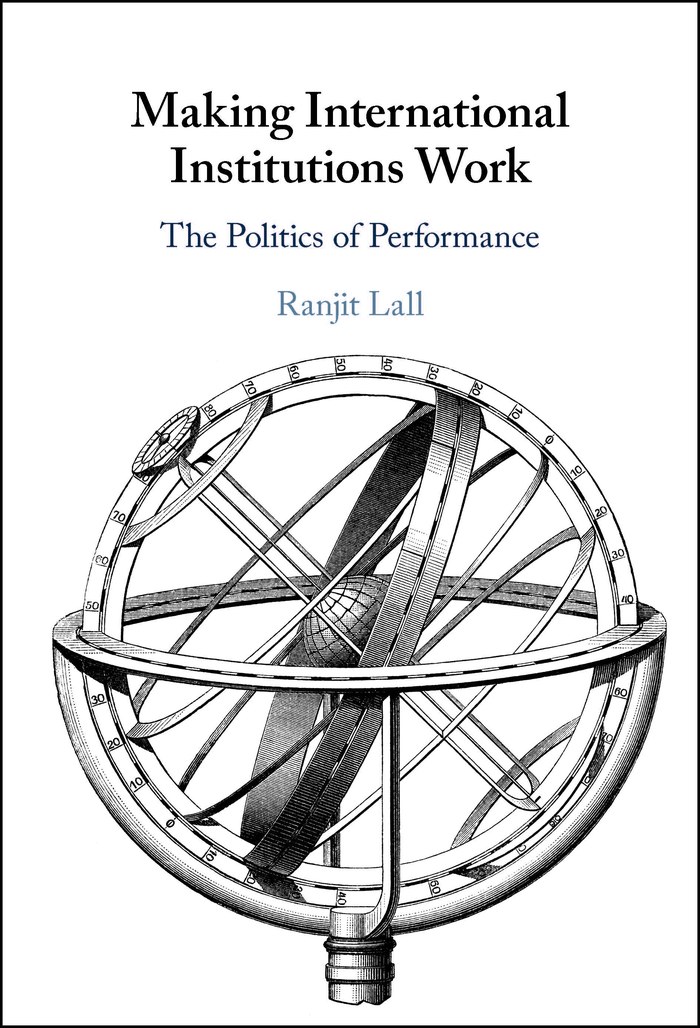
Making International Institutions Work
The Politics of Performance
Why do some international institutions succeed where others fail? The book argues that the gravest threat to performance comes not from runaway bureaucrats but from the states that create institutions in the first place — and that the quiet processes by which international officials build autonomy are what make institutions work.
Performance is political
International institutions are essential for tackling the most urgent challenges facing the world, from pandemics to humanitarian crises. Yet we know remarkably little about when they succeed, when they fail, and why.
The conventional answer blames the institutions themselves — the “runaway bureaucracy” that drifts from the purposes its founders intended. The book argues close to the opposite. The most serious threat to performance comes from states pursuing narrow national interests through the very institutions they created and gave purpose to.
What protects an institution, on this account, is de facto policy autonomy: not the formal independence written into a charter, but autonomy built in practice, through operational alliances with actors above and below the state and through work that is genuinely difficult for governments to monitor.
The theory is tested against a diverse body of evidence — the most comprehensive dataset assembled on the topic, an original survey of institutional staff, and paired case studies in global food security and global health.
Seven chapters
412 pages, Cambridge University Press, 2023.
International Institutions and the Performance Puzzle
A Theory of Institutional Performance
Learning from Assessment: Quantitative Tests on Fifty-Four Institutions
Performing for Scraps: Comparing the FAO, the WFP, and IFAD
The Performance of Life: Comparing the WHO, UNAIDS, Gavi, and GFATM
Effective but Unaccountable? Autonomy and the Politics of Reform
The Politics of Performance: Contributions and Implications
Endorsements
A fascinating book that stands much of the conventional wisdom on what makes for effective international governance on its head. Ranjit Lall has written a deeply original and meticulously researched book that sets the standard for future work in this area.
Ranjit Lall’s original and persuasive argument is that institutional performance depends on linkages to transnational networks and deep engagement with civil society, which enhance policy autonomy and limit state interference. All serious students of international institutions should read this book.
The path to more effective international institutions lies not through formal institutional rules but through international organizations developing operational advantages that states need but cannot interfere with, coupled with pursuing projects through informal partnerships with nonstate actors and transgovernmental networks. Ranjit Lall supports his persuasive argument with extensive data and case studies explaining the comparative performance of a wide range of international organizations.
Why do some international institutions perform well at providing critical public goods for the world’s people, while others fail? Lall provides a powerful explanation using new data from multiple sources. International institutions need a minimal level of autonomy from the states that created them to function well, and they can attain this by employing the same clever strategies that people and governments follow: making alliances and exploiting informational advantages. His book provides a clear guide for scholars and policymakers on how to make international institutions work for the world.
Book reviews
Reviews and review essays across international relations, political science, public administration, and international law.
-
The Review of International Organizations Felicity Vabulas, Pepperdine University · 2023, 18(4), 783–787 Read →
… a welcome reminder that performance of IIs has varied greatly: many IIs have also succeeded in performing important tasks that make the world a better place.
-
Scholars, students, and general readers alike will highly appreciate this theory-guided empirical research. Furthermore, the book lays the groundwork for new ways of thinking and understanding institutional performance.
-
… this impressive book embodies an important step towards greater appreciation of the promises and the limits of cooperating through international institutions.
-
Political Science Quarterly Edward D. Mansfield, University of Pennsylvania · 2025, 140(2), 327–341 · review essay Read →
Makes “a significant contribution to our understanding of the performance of IOs”, and one Mansfield engages at essay length, re-estimating the models on Lall’s published data.
-
International Studies Review Diego Dewar Viscarra, Blavatnik School of Government, Oxford · 2024, 26(2), viae017 Read →
The argument “advances International Relations theory by challenging realism”, with the Jekyll and Hyde problem singled out as among the book’s most relevant contributions.
-
Governance Tatiana Cruz and Tana Johnson, University of Wisconsin–Madison · 2024, 37(2), 681–683 Read →
“This book should be read by practitioners and scholars alike” — credited with a tightly woven argument and empirics that are both diverse and systematic.
-
International Organizations Law Review Jan Klabbers, Whewell Professor of International Law, University of Cambridge · 2026, 23, 101–128 Read →
The book “will become the benchmark for further work on the performance of international organizations”.
Writing about the book
A short piece setting out the book’s central findings on the performance–accountability trade-off for a policy audience.
Making UN boards more strategic: the WFP governance review ReformWorks · by Katja HemmerichApplies the book’s findings on accountability mechanisms and non-state participation to the WFP Executive Board’s review of its own governance.
A new theory of why international institutions fail and succeed Department of Politics and International Relations, OxfordDepartmental news item on the book’s publication.
Nuffield College, May 2023
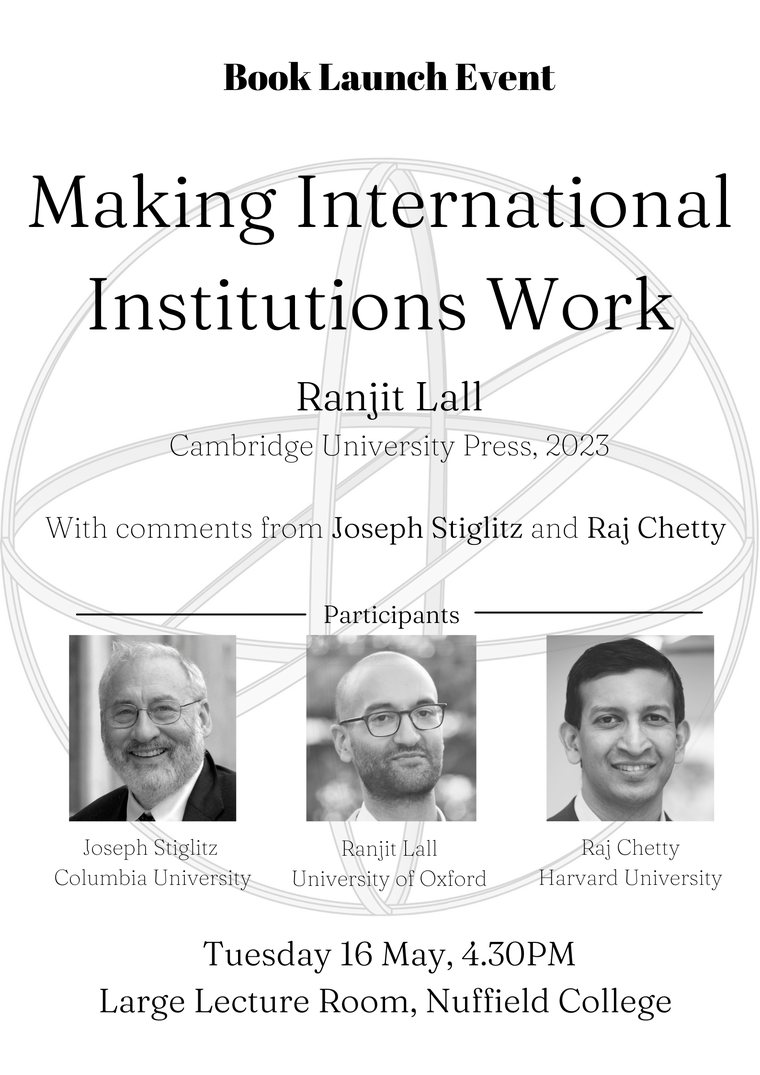
The book was launched at Nuffield College, Oxford, three months after publication. It was chaired by Duncan Snidal, with comments from economists and political scientists whose work bears directly on the questions it takes up — the design of institutions, the measurement of opportunity, and the politics of international cooperation.
The discussion ranged over the book’s central claim — that the gravest threat to institutional performance comes from member states rather than from international bureaucrats — and over what follows from it for the reform of multilateral organisations at a moment when several are under strain.
- Duncan SnidalChairUniversity of Oxford
- Joseph StiglitzColumbia University
- Raj ChettyHarvard University
- Ranjit LallUniversity of Oxford